Construction
Nov 16, 2026
The Timber Moisture Clock: Why Framing Gets Enclosed Before Its Moisture Content Is Ever Verified
The Timber Moisture Clock: Why Framing Gets Enclosed Before Its Moisture Content Is Ever Verified

The Timber Moisture Clock: Why Framing Gets Enclosed Before Its Moisture Content Is Ever Verified
Timber framing is often installed and enclosed on the strength of a delivery description, not a verified condition. A kiln-dried label records a product claim or process history. It does not establish the moisture content (MC) of each member when it arrives, after storage, or at the point of enclosure.
That distinction matters. Timber can be wetted by rain, stored in a poorly ventilated stack, or placed close to damp ground. It may then be installed and covered before anyone takes representative readings. Once the building dries in, framing can continue to lose or gain moisture as it moves toward equilibrium with its surrounding environment.
This creates a gap between physical site execution and construction compliance evidence. The crew may have completed the framing sequence; the oversight team may have signed off a visual inspection. Neither fact demonstrates what the timber’s moisture condition was, or what movement to expect after enclosure.
The consequences can appear later: shrinkage, dimensional drift, gaps, cracking at joints, fastener-related lining damage and floor squeaks. These symptoms are not proof of a single cause. They are reasons to examine the moisture history, measurement record and sequence of enclosure.
Separate the timber’s condition into three points: as delivered, as stored and as installed. A supplier’s kiln-dried designation may be relevant evidence, but it is not a site measurement. It cannot account for exposure after dispatch, the conditions of transport, or water absorbed during construction.
Record the timber species or species group when known, delivery date, storage arrangement, weather exposure and any visible wetting. Protect the stack from direct precipitation while preserving ventilation; avoid ground contact and stacking arrangements that trap water. Photograph conditions before they are changed.
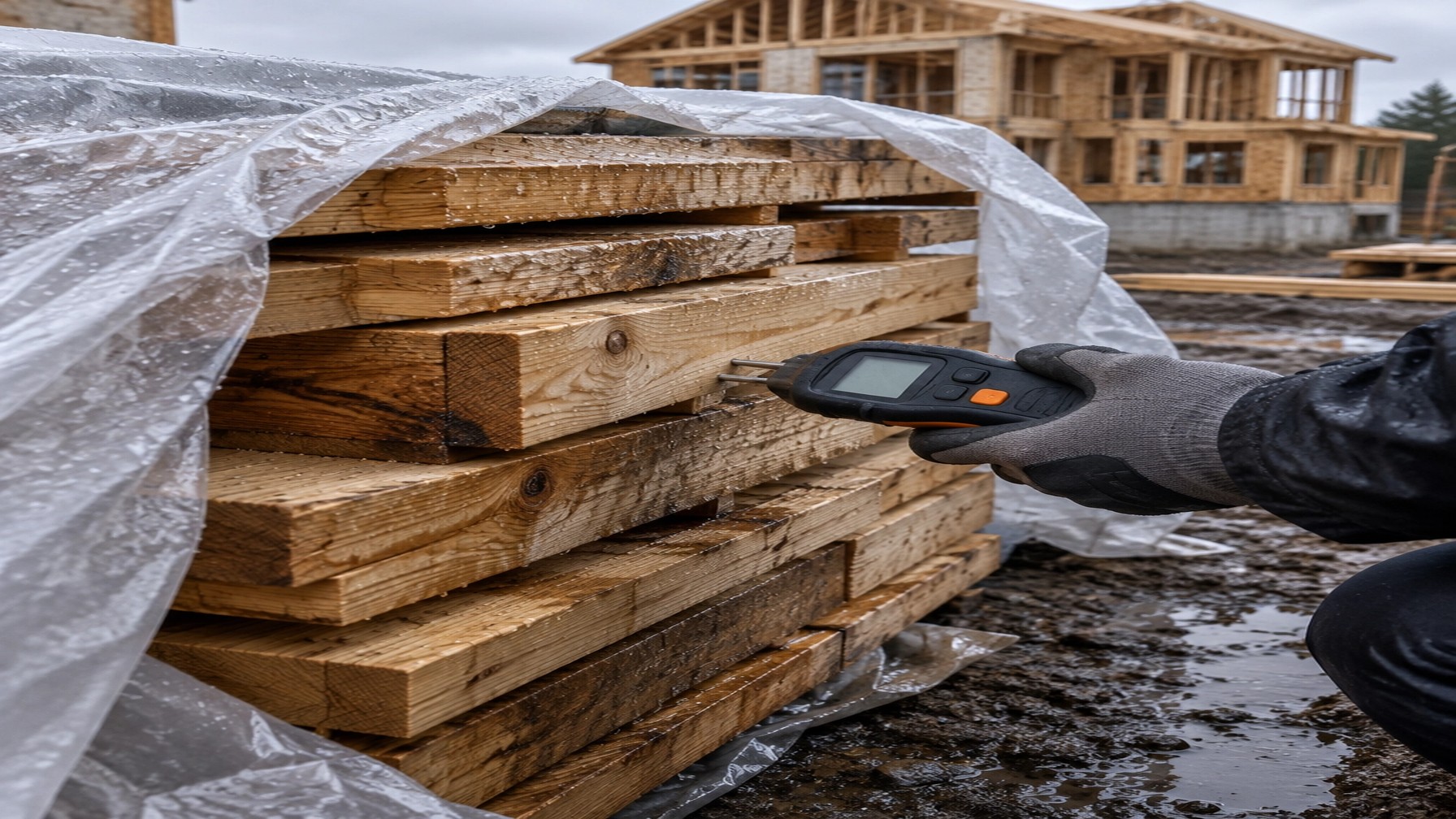
A handheld meter produces an indication at a particular location and depth. Its result may be affected by species, temperature, density, grain direction, meter technology, probe configuration and moisture gradients within a member. A surface reading cannot automatically stand in for the core, the full length of a stud, or the whole framing package.
More importantly, a reading taken on enclosure day describes the measured condition then. It does not predict post-dry-in behaviour. After enclosure, framing may continue to exchange moisture with the indoor environment. Species, member dimensions, starting moisture condition, temperature and relative humidity all influence how that process unfolds.
Track moisture readings alongside the conditions that help interpret them. Document date, location, member identification, meter type and mode, probe depth, species correction, temperature correction and ambient conditions. Take representative readings in risk locations, including areas with known rain exposure or restricted airflow. Where the consequences justify it, verify selected samples using a direct oven-dry method.
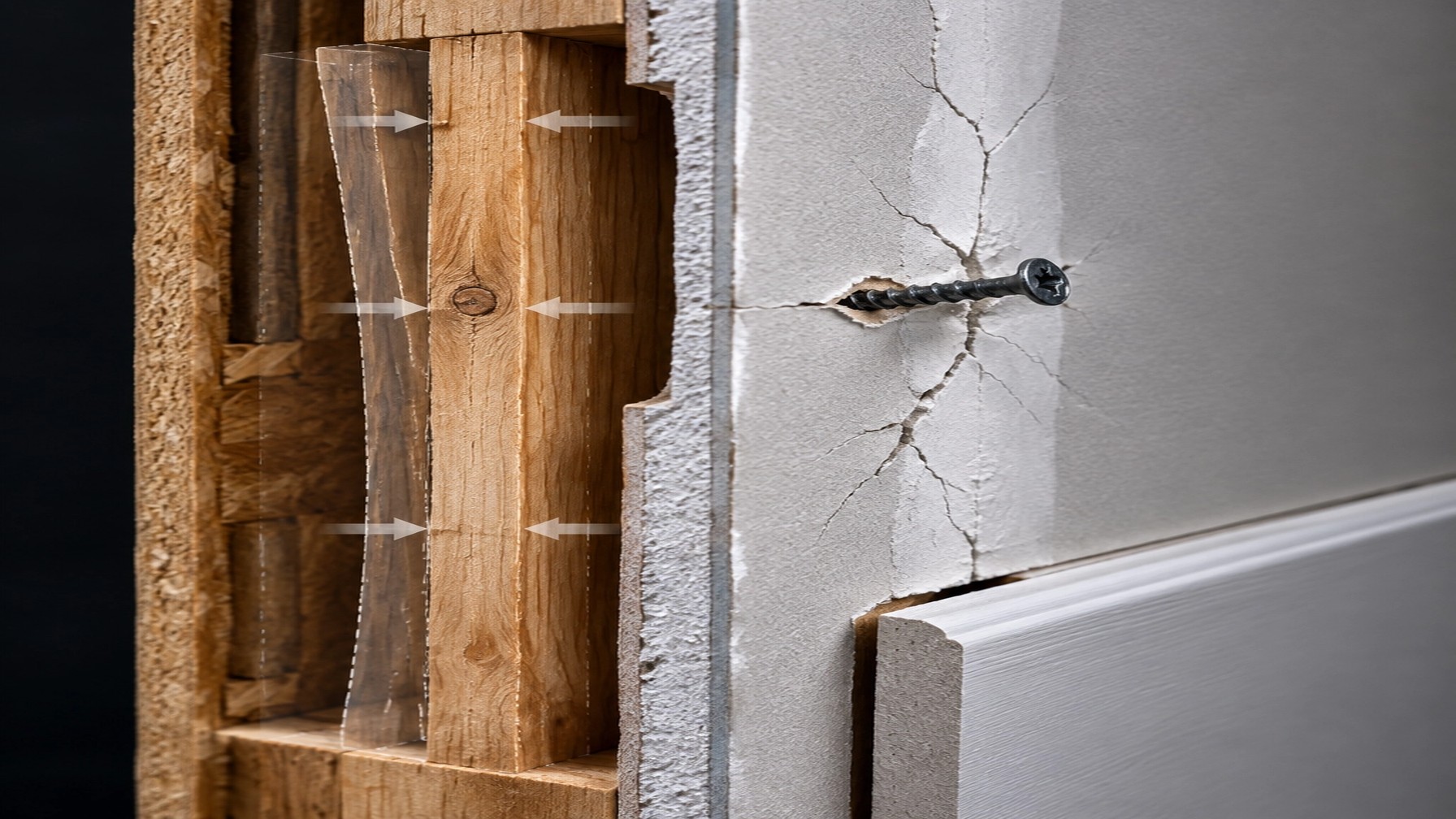
As wood dries below the fibre-saturation region, loss of bound water from the cell walls produces shrinkage. Movement is much greater across the grain than along it. The amount varies with species, grain orientation, dimensions and initial condition.
After enclosure, dimensional change can affect interfaces between framing, lining, fasteners, flooring and finishes. Depending on the assembly and restraint, movement may contribute to drywall stress cracks, gaps, fastener pull-through, floor squeaks or other signs of drift. These are possible outcomes, not automatic results of a particular reading. Investigate the assembly and competing causes before assigning responsibility.
Responsibility often falls between parties. The supplier provides documentation; the contractor controls storage and sequencing; the inspector may be engaged for a limited visual review; the owner may assume somebody else has verified moisture.
Set the decision owner before framing begins. Define who selects measurement locations, who records results, who decides whether the evidence is sufficient for enclosure, and who can release the hold point. A visual quality inspection, a contractor’s self-check and an independent forensic review are different engagement models. State the scope and limits of each. Do not let a narrow visual audit be treated as proof of an unmeasured property.
Use these international references to distinguish direct measurement, meter calibration and conditioning:
These standards describe methods and scope; they do not, by themselves, set a universal project acceptance threshold. A meter reading is not equivalent to a direct measurement. Apply appropriate species and temperature corrections, and record the instrument, measurement location and method. Use direct testing when a defensible reference value is required. Treat any reading taken at enclosure as a time-specific observation, not a prediction of post-dry-in behaviour.
Specify a framing moisture verification hold point before concealment. Define the inspection scope, representative sampling approach, documentation requirements and person authorized to release the hold. Set project-specific acceptance criteria with reference to the timber specification, assembly requirements and intended service environment; do not assume one number suits every species, member or project.
Inspect storage and exposure conditions before measuring. Where wetting is suspected, increase sampling in affected areas and assess whether the wood is drying, stable or being rewetted. Pair repeat readings with temperature and relative-humidity observations. If readings are disputed or the risk is material, select representative samples for direct oven-dry determination.
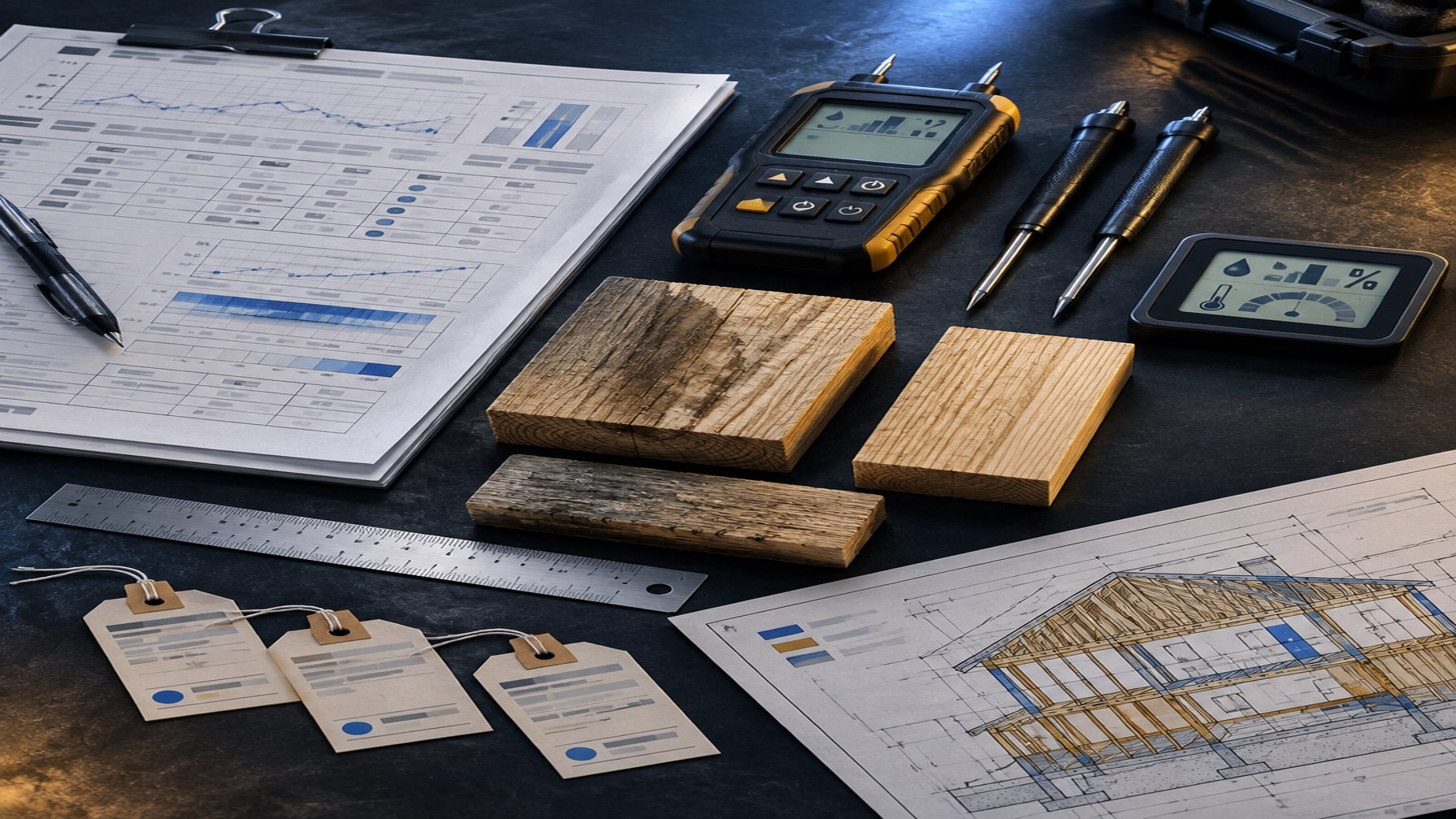
Keep the verification record with project documentation. Include the timber identification, locations measured, date and time, meter details, corrections applied, observed storage conditions, results and the release decision. Photograph the framing and measurement process before linings cover access.
This record makes later diagnosis more disciplined. It helps distinguish a moisture-related movement issue from installation tolerances, restraint, material variation or other causes. It also reduces friction between contractors and oversight bodies by showing what was checked, by whom and against which project criteria.
A home renovation consultant or construction consultant can help owners and builders define these evidence requirements early. In residential project management, treat this as a construction compliance evidence gap, not a cosmetic checklist item. Construction risk management services should clarify who owns verification and what happens when the evidence is incomplete. For readers using the search phrase “custom home build consultant Australia,” the underlying need is the same: independent decision support, not an assumed measurement or jurisdiction-specific compliance promise. Effective construction advisory australia services bridge site execution and oversight before a preventable uncertainty escalates into a commercial or legal dispute.
For builders, see Construction Advisory; for homeowners, see Residential Project Support. For expert-network access, connect with The Hive to support evidence-led project decisions.
Watch more construction intelligence on the Shoal Bay Projects Hive YouTube channel.
⚠️ The image in this post is used for illustration purposes only, designed to encourage thoughtful discussion. It is not intended to represent a prescriptive detail of any installation or construction method.
Claim Your Foundation Membership
The Vault. The App. The Community. We're opening the doors to a select group of Foundation Members. Free, for a limited time. Foundation Membership includes full access to The Vault (our forensic intelligence archive) and early access to the Hive app.
Once the charter window closes, this tier is gone permanently. Foundation Members retain access for life. This is not a trial: it's a permanent invitation to the founding cohort.
Claim Your Foundation Membership →
Quick discussion prompt for the community: what evidence should be in place before timber framing is covered?
The Timber Moisture Clock: Why Framing Gets Enclosed Before Its Moisture Content Is Ever Verified
Publication home: The Hive
Image assets: