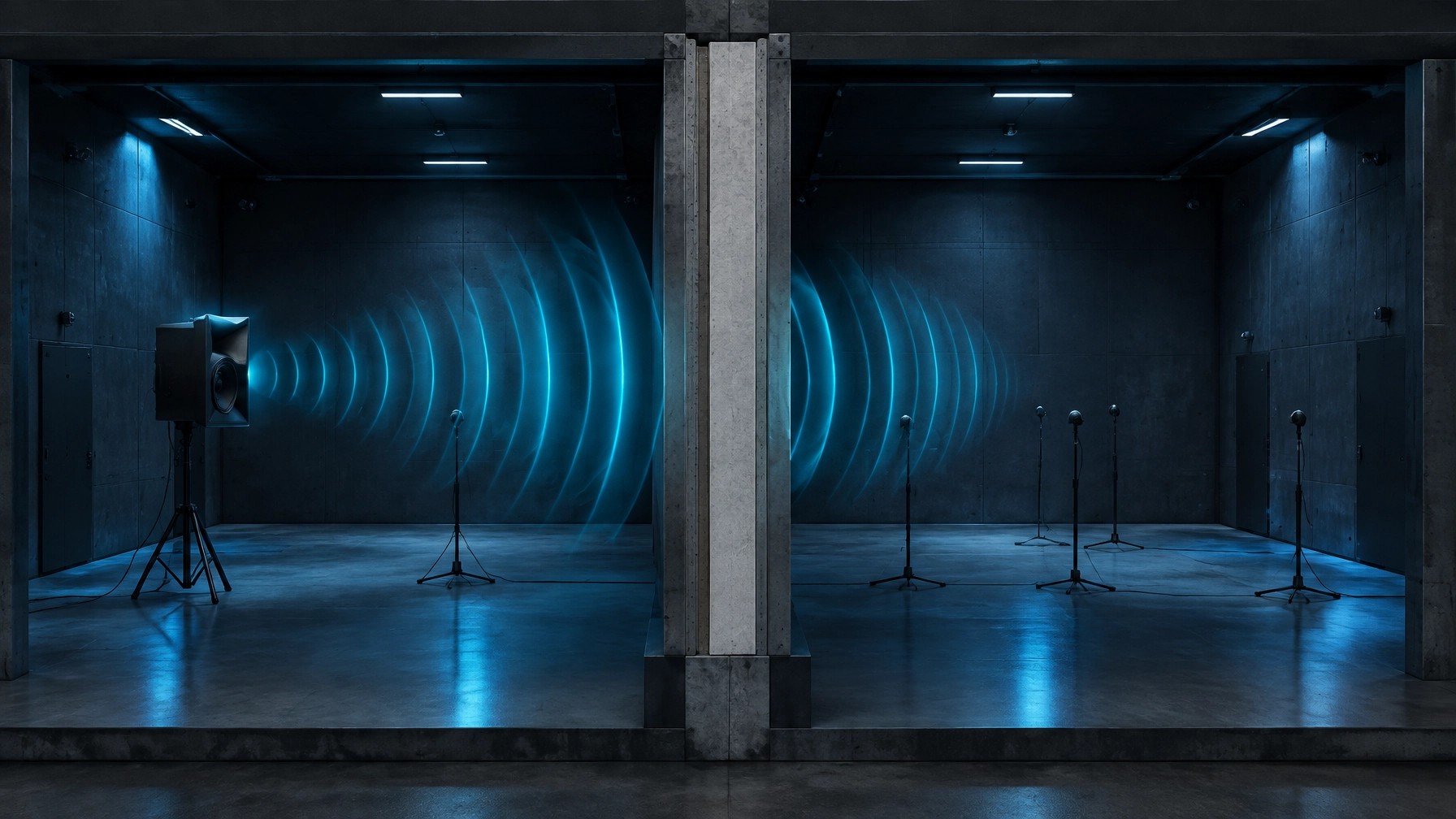
“Shower leaking after handover.”
“Water stain on the ceiling below the bathroom.”
“Grout keeps going black.”
“Damp smell in the wardrobe.”
“Is this normal?”
If water is appearing where it should not, the waterproofing system has already failed in some form. It will not correct itself. A leaking shower after handover is not a cosmetic issue and it is not a maintenance issue. It is a defect with a cause that predates the tiling.
Waterproofing failure is one of the most searched residential defect questions, one of the leading causes of building disputes, and one of the most common serious defects found in new residential construction.
The honest answer comes first because the remedy depends on it.
The visible leak may appear after handover, but the decision that created the leak was often made months earlier, during framing, substrate preparation, drainage set out or wet area coordination.
The membrane is usually the last trade in and the first trade blamed. In many cases, it is the messenger, not the cause.
The through line for this entire forensic series is simple:
Visually intact does not equal performing.
Problem: The leak appears after handover, but the defect began earlier
A finished shower gives the impression of a sealed system. Tiles are straight. Joints are filled. The drain is installed. The wall surfaces look complete. A flood test may have been recorded. A compliance certificate may have been issued.
Then the symptoms begin.
A ceiling below the bathroom develops a brown stain. A wardrobe develops a damp smell. The grout darkens repeatedly in one corner. Paint blisters on the adjacent wall. The shower base remains wet long after use. Mould returns even after cleaning.
The immediate assumption is usually that the membrane has failed.
That assumption is too narrow.
A shower is not waterproof because a membrane exists somewhere below the tiles. It performs only when the substrate, falls, drainage interface, framing, movement details, penetrations, adhesive, screed, membrane and finishing sequence operate as one continuous system.
The membrane cannot correct a flat substrate.
It cannot restore a damaged or contaminated surface.
It cannot accommodate movement where no movement detail exists.
It cannot remain continuous after a later trade punctures it.
It cannot make a poorly coordinated drain interface perform.
It cannot stop water collecting at a low point that was created before the membrane was installed.
The forensic question is therefore not:
“Did the waterproofing trade apply the membrane?”
The forensic question is:
“Was the complete water management system capable of performing before the membrane was applied, and did it remain intact until concealment?”
That distinction changes the entire investigation.
The visible event is a waterproofing failure, but the mechanism is systemic
A shower leak is an outcome. It is not automatically a diagnosis.
The failure may involve:
- Incorrect framing or floor set out
- Inadequate fall to the drain
- A substrate that is contaminated, weak or too wet
- Unresolved movement between materials
- A discontinuous membrane line
- An unsealed penetration
- A drain interface that does not transfer water into the drainage path
- A screed that reverses the intended fall
- Tiling or finishing work that punctures the membrane
- A plumbing leak that is incorrectly attributed to waterproofing
- A threshold or hob that allows water to escape the designated wet area
This is why a sealant bead, a replacement grout joint or a small patch of membrane is not automatically a rectification.
A repair treats the visible symptom.
A rectification of cause identifies why water was able to leave the designated containment zone and restores the performance of the complete assembly.
Forensic Analysis: The system starts before the membrane
Substrate, fall, framing and set out establish the outcome
The membrane is only one layer within a sequence.
The sequence begins with framing and set out. Framing establishes the location of the walls, the position of the shower, the height of the threshold, the relationship between the floor and the drain, and the space available for the screed and tile build up.
Substrate preparation establishes whether the membrane can bond and whether the surface can support the layers above it.
Falls establish whether water moves toward the drain or remains trapped.
Drainage set out establishes whether water has a continuous path out of the wet area.
Only then can the membrane provide its intended function.
This is why the title of this article is deliberately forensic. The cause may be decided at framing stage even though the symptom is not visible until handover.
If the framing creates a recess that cannot achieve the required fall without excessive build up, the problem already exists.
If the drain is positioned without allowing a consistent fall from all relevant points, the problem already exists.
If a wall line forces the shower screen or hob into a position that creates a low point at the threshold, the problem already exists.
If the substrate is not designed to receive the selected membrane and tile system, the problem already exists.
The membrane arrives at the end of a decision chain. It cannot reverse that chain.
Fall and drainage geometry, the hidden pond
Water does not respond to appearance. It follows geometry.
A shower floor can look visually level and still contain a low point. It can pass a basic visual inspection and still direct water away from the drain. It can have a strong fall during construction and lose effective drainage after screed, adhesive and tiling alter the finished profile.
The intended drainage path must be assessed through the entire build up, not only at one exposed stage.
Consider a simplified sequence:
- The structural substrate is formed.
- A membrane is installed.
- A screed is placed.
- Adhesive is applied.
- Tiles are installed.
- Grout and finishing elements are added.
Each layer changes the geometry. A fall checked on the substrate may not be the same fall that exists at the finished tile surface. A drain that appears correctly positioned before the screed may become a local high point after the tile build up. A screed that appears to fall toward the drain may create a shallow depression at a corner or threshold once the finishing layer is installed.
The critical question is not whether a fall was observed at one point in time.
The critical question is whether the completed system directs water reliably to the intended drainage point without creating persistent ponding, lateral migration or saturation of adjacent materials.
A flat or back falling substrate turns a compliant membrane into a pond.
The membrane may remain visually intact while water sits against a junction, penetrates a discontinuity or remains trapped below the screed. The membrane has then become a holding surface for water rather than a functioning part of a drainage system.
The low point is not always the drain.
That single fact explains many post handover disputes.
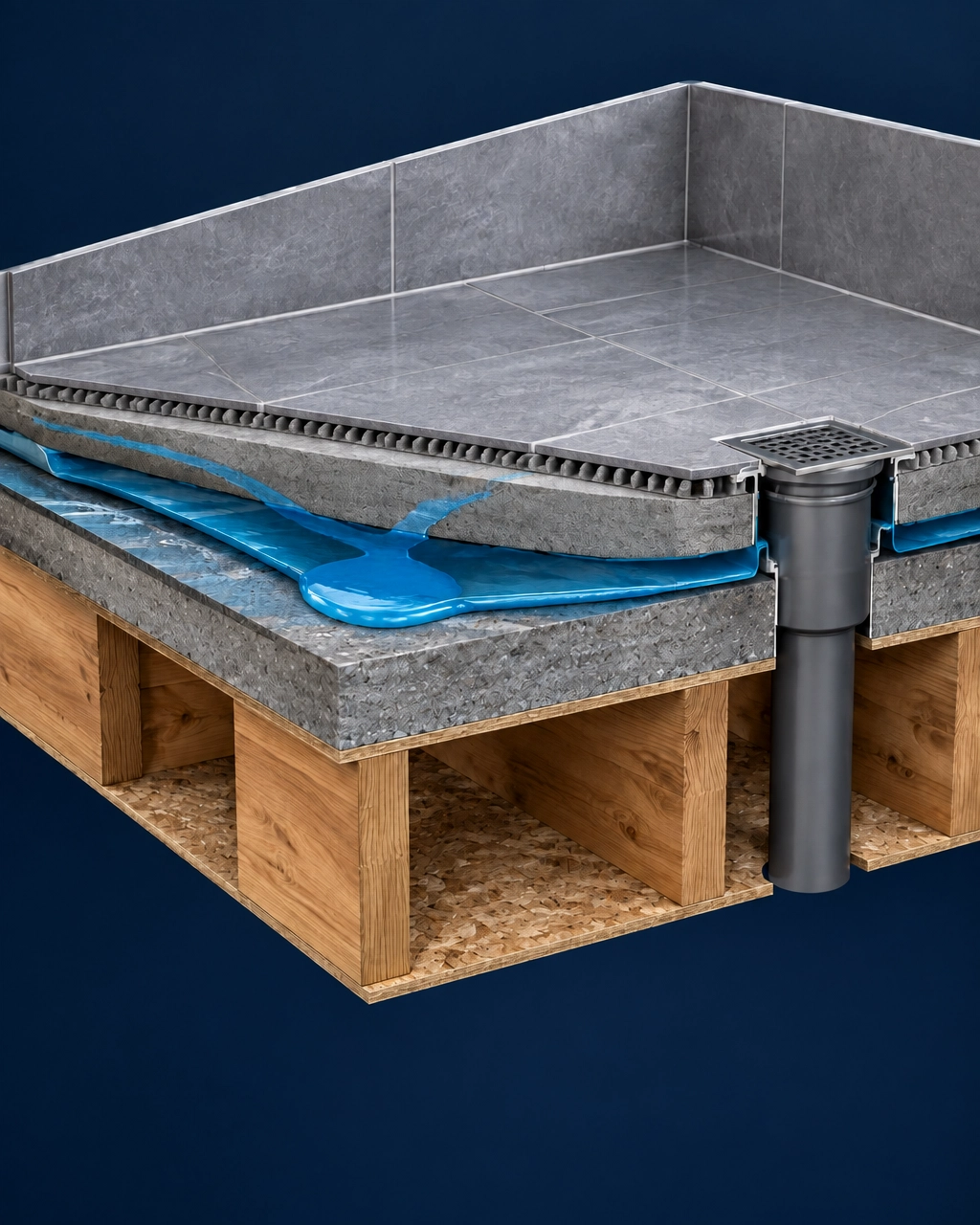
A strong fall test during construction is not the same as a fall that survives screed and tiling.
Verify:
- The intended fall from every relevant corner and edge
- The drain elevation relative to the membrane and finished tile
- The fall after screed placement
- The finished fall after tile installation
- The absence of local depressions at corners, thresholds and penetrations
- The continuity of the drainage path below the finishing layer
Document the result before concealment.
Movement causes failures at junctions before the field
Waterproofing failures rarely begin in the middle of an uninterrupted membrane field.
They begin at transitions.
The most exposed locations are usually:
- Wall and floor junctions
- Internal corners
- Movement joints
- Penetrations
- Drain bodies
- Door thresholds
- Hob junctions
- Changes between rigid and flexible substrates
- Changes between framed and masonry construction
- Terminations at adjacent finishes
These are the points where different materials move differently.
A concrete substrate may shrink, expand or crack differently from a screed. A framed wall may move relative to a floor. A rigid tile assembly may respond differently from a flexible membrane. A drain body may remain fixed while the surrounding substrate experiences movement.
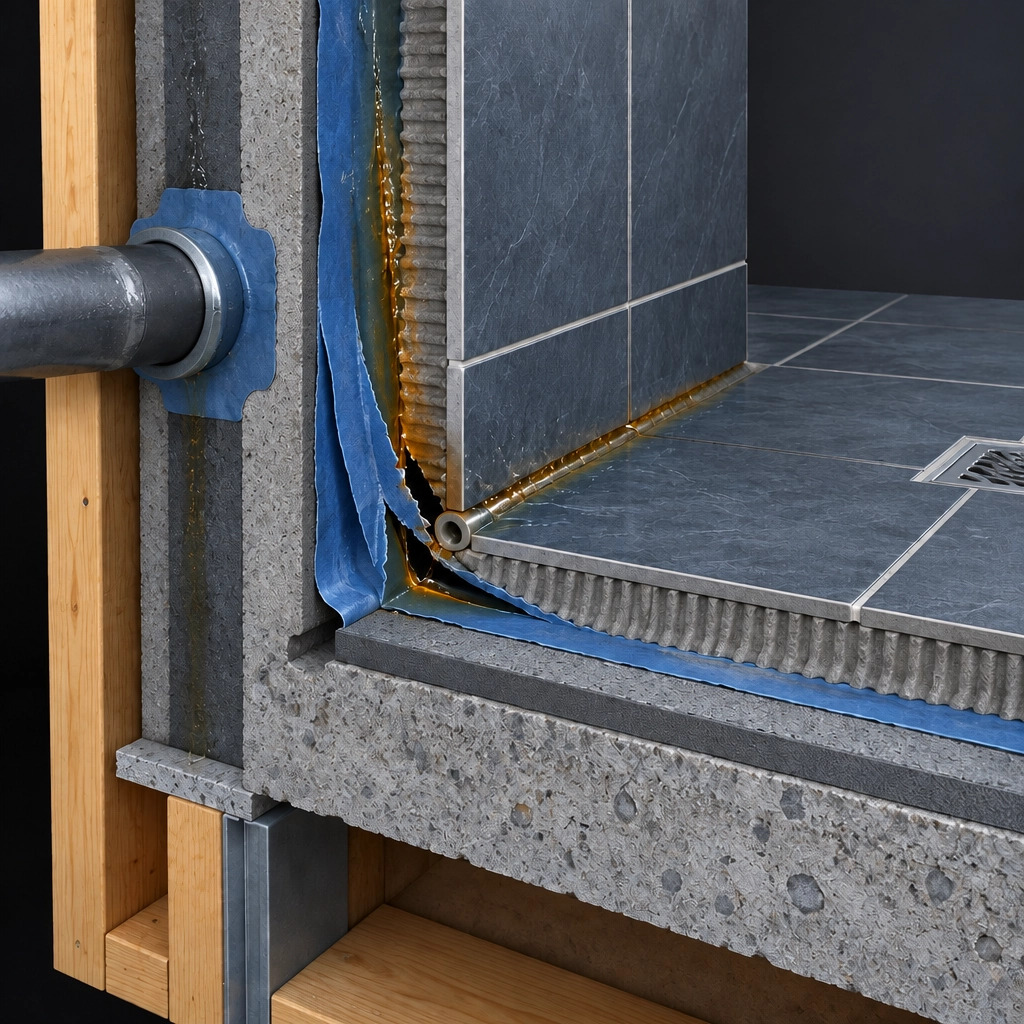
If the system does not provide movement accommodation at these interfaces, the membrane is forced to absorb movement for which it was not designed.
The membrane may stretch, shear, debond or tear. The visible failure may not appear immediately. It may develop progressively as the shower cycles through wetting, drying, heating, cooling and normal building movement.
A junction is therefore not a minor finishing detail. It is a structural and water management interface.
Bond breakers are movement details, not decorative accessories
A bond breaker separates the movement behaviour of adjacent components so the membrane is not forced to bridge a rigid connection.
Where a membrane is fully bonded across a junction that needs to move, the membrane can be placed under tension as the materials change position. The resulting stress concentrates at the corner or joint. The membrane may then split, detach or lose continuity.
The defect is not necessarily visible in the membrane field. It is concentrated at the transition.
This is why bond breaker detailing at movement junctions is a structural requirement within the water management logic of the assembly. It is not a nicety added for appearance or trade preference.
Specify the movement detail before waterproofing begins.
Verify that the detail is compatible with:
- The substrate type
- The membrane system
- The screed
- The tile adhesive
- The expected movement
- The location of the joint
- The sequence of installation
- The termination and return of the waterproofing line
Do not treat movement accommodation as something that can be added after the membrane has already been applied.
Substrate preparation decides the adhesion chain
Adhesion failure is almost always decided before the membrane is applied.
The membrane may be correctly selected and correctly installed according to its application instructions, yet fail because the surface beneath it was not suitable.
Common substrate conditions that compromise adhesion include:
- Dust
- Laitance
- Loose particles
- Weak or friable screed
- Release agents
- Curing compounds
- Oil or other contamination
- Excess surface moisture
- Incompatible primers
- Unresolved cracks
- Uneven transitions
- Inadequate curing
- Residual construction debris
The adhesion chain is only as strong as its weakest interface.
If the membrane bonds to dust rather than to the substrate, the installation may look complete while the effective bond is already compromised. If the screed is weak, the membrane may remain attached to a layer that later delaminates from the substrate. If moisture is trapped beneath a system that requires a dry surface, adhesion and curing may be affected.
This is why “the membrane was applied” is not evidence of performance.
Record:
- Substrate condition
- Surface cleanliness
- Moisture condition
- Curing status
- Primer selection
- Repairs completed before membrane installation
- Compatibility between substrate and membrane
- Environmental conditions during application
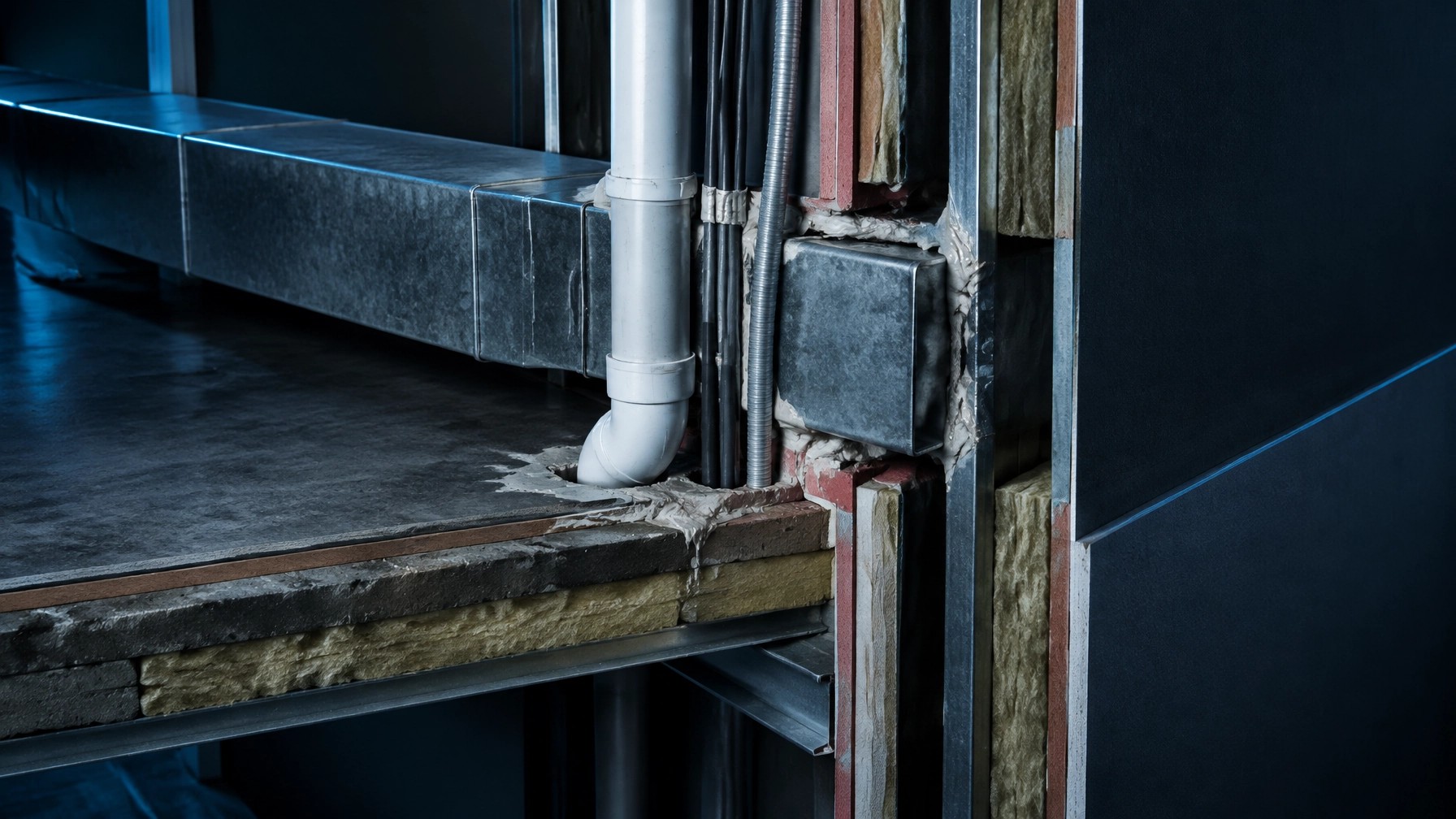
Penetration interfaces are primary failure vectors
A continuous waterproofing line becomes discontinuous when it reaches an interface that has not been properly detailed.
Critical penetration interfaces include:
- Floor wastes
- Shower outlets
- Mixer penetrations
- Tapware
- Door thresholds
- Hobs
- Linear drain bodies
- Pipe sleeves
- Screen supports
- Fixings
- Service penetrations
Each interface can involve different materials, different movement and different installation ownership.
A membrane field may be correctly applied, but the system can still fail where the membrane meets the drain body. A wall penetration may be sealed at the visible surface while the concealed interface remains open. A threshold may appear finished while the waterproofing line stops short of the area exposed to regular spray and cleaning water.
At a linear drain, the membrane must remain continuous to the drainage interface. At a floor waste, the membrane must connect to the drain assembly without relying on a superficial surface seal. At tapware penetrations, the detail must account for the relationship between the wall substrate, service fitting and membrane.
Penetrations should be treated as forensic control points.
Verify:
- The location of each penetration before waterproofing
- The membrane continuity around the penetration
- The compatibility of collars, sealants and membrane materials
- The absence of unsupported gaps
- The absence of unsealed fasteners
- The condition after plumbing and finishing work
- The relationship between penetrations and the designated wet area boundary
Screed and tiling can defeat an otherwise sound membrane
The waterproofing system can be compromised by work carried out after the membrane trade has left.
Typical sequence failures include:
- Screed laid without the required fall
- Screed installed after the membrane without coordinated compatibility
- Tile adhesive incompatible with the membrane
- Fixings driven through the membrane
- Door hardware installed through a concealed waterproofing zone
- Screen supports drilled into the wet area floor
- Membrane punctured by later trades
- Sharp debris left on the membrane before screed placement
- Tile build up creating a reverse fall
- Drain grates raised or lowered without coordinating the complete assembly
The critical principle is simple:
A membrane is not protected merely because it has been certified.
It is protected only when subsequent trades preserve its continuity.
The most serious sequence inversion occurs when waterproofing is treated as a completed task rather than a controlled stage within a larger system. The membrane is installed, inspected and photographed, but later trades modify the substrate, install fixings, change the drain height or add a threshold without a new verification point.
The result is a compliance record that describes an earlier condition, not the condition concealed at handover.
The unowned interface pattern
The waterproofing trade is often sandwiched between wet trades and finishing trades.
The plumber installs the drainage and service penetrations. The carpenter or framing trade creates the enclosure. The substrate trade prepares the surface. The waterproofing trade applies the membrane. The screeder alters the floor geometry. The tiler covers the system. The glazing or door trade adds thresholds and fixings.
Each trade controls a part of the outcome.
No single trade necessarily owns the complete interface.
This is the unowned interface pattern.
It creates predictable friction between contractors and oversight bodies. The waterproofing installer may say the substrate was not ready. The tiler may say the membrane was already defective. The builder may rely on a certificate. The inspector may have observed only the exposed work. The homeowner sees only the finished shower and the resulting damage.
The dispute then becomes a contest of assumptions.
A forensic advisory process assigns ownership of the interface before installation. It identifies who must verify the substrate, who must approve the fall, who controls penetrations, who protects the membrane and who releases the area for concealment.
Without that assignment, every trade can be technically correct about its own limited scope while the complete shower still fails.
The concealment problem
Once tiled, the evidence is inaccessible.
The membrane, bond breaker, substrate, drain connection and lower junctions disappear beneath adhesive, tile and grout. The installation record may contain a few photographs, but those photographs often show only broad areas rather than the decisive interfaces.
When a leak appears, the investigator is asked to determine what happened without seeing the condition that existed before concealment.
That is not a normal inspection problem. It is an evidence problem.
A visual inspection may identify staining, cracked grout, missing sealant or damaged finishes. It may not identify:
- A membrane termination that stops short
- A low point below the screed
- Adhesion loss beneath the membrane
- A blocked drainage path
- A puncture beneath a tile
- A failed drain interface
- A movement tear at a covered junction
- Moisture trapped within the substrate
- A concealed plumbing defect
The inspection must therefore be designed around causation, not appearance.
Use moisture mapping, controlled water testing, service isolation, drain testing, targeted opening up and document review where justified. Establish the leak path before selecting the remedy.
Do not destroy evidence casually. Photograph and record the condition before removing tiles, cutting walls or applying a patch.
The handover illusion
Flood testing and compliance certificates have value, but their evidentiary value is limited.
A passed flood test proves that the system held water under the test conditions on the day.
It proves nothing by itself about:
- Long term adhesion
- Movement accommodation
- The condition of the substrate beneath the membrane
- The performance of the screed and tile build up
- The effect of later trade work
- A puncture created after testing
- The durability of a penetration interface
- A plumbing leak under operating pressure
- A threshold that allows water to escape during normal use
The certificate records a condition at a point in time.
It does not automatically prove performance over the service life of the shower.
This is the same distinction that appears throughout construction compliance. A document can confirm that a process occurred. It cannot, without supporting evidence, establish that the installed system will perform under actual service conditions.
Visually intact does not equal performing.
Cluster Cross Links: Position the shower failure within the wider system
The shower should not be analysed as an isolated tile problem.
In The Sealant Fallacy, the focus is the mistaken belief that the joint itself is the leak and that a new bead of sealant is therefore a complete solution. The same logic applies in showers. The visible joint may be the symptom of movement, drainage or membrane discontinuity.
The Hidden Drainage Plane addresses the concealed pathways that manage water after it passes beyond the visible finish. A tiled shower has the same fundamental requirement: water must be controlled, collected and directed through a continuous hidden plane.
The Vapour Control Inversion examines the difference between specifying a control layer and placing that layer correctly within an assembly. The principle is directly relevant to waterproofing. A correct membrane in the wrong position, or a correct membrane separated from its intended drainage path, can still fail.
For external wet areas, The Forensic Anatomy of Balcony Waterproofing Failures examines penetration interfaces as primary failure vectors. The shower is smaller, but the forensic mechanism is similar. Transitions, penetrations, thresholds and terminations carry disproportionate risk.
Standard Reference: Outcome based principles, not paperwork alone
A credible waterproofing framework is outcome based.
It does not begin and end with whether a certificate exists. It asks whether the completed system achieves the required performance under intended use and over the expected service life.
Across credible international performance frameworks, the underlying principles are consistent.
Continuity of the waterproofing line
The waterproofing line must remain continuous around the designated wet area, including corners, junctions, penetrations, thresholds, hobs and drainage interfaces.
A gap at an interface can be more significant than a defect in the middle of a membrane sheet because the interface combines water exposure, movement and material change.
Correct substrate and adhesion
The membrane must be installed onto a sound, clean and suitable substrate.
The substrate must support the membrane and the layers above it. The membrane must be compatible with adjacent materials. Adhesion must be considered as part of the system, not as an isolated product characteristic.
Appropriate fall and drainage
The completed assembly must move water toward the intended drainage point.
The fall must be considered across the finished build up, not only at the earliest exposed stage. Ponding, reverse fall and local depressions are performance failures even where the membrane appears intact.
Movement accommodation at junctions
The system must accommodate movement between dissimilar materials and at designed movement locations.
Bond breakers, flexible transitions and movement joints are part of the performance design. They are not optional finishing details.
Compatibility between layers
The substrate, primer, membrane, adhesive, screed and tiles must operate together.
Compatibility includes adhesion, curing, moisture behaviour, chemical interaction, movement and installation sequence.
Verification before concealment
The decisive stages must be inspected and recorded before they disappear.
International quality and information management principles place importance on traceable records, controlled hold points, responsibility allocation, verification and preservation of evidence.
A waterproofing record should therefore show more than a signed form. It should show:
- What was inspected
- Who inspected it
- When it was inspected
- What condition was observed
- What was corrected
- What was photographed
- What was concealed afterward
- Which later trades accessed the area
- Whether the final condition was reverified
The framework asks for outcomes.
The site delivers geometry, interfaces, sequence and evidence.
Actionable Fix: What to do when the shower starts leaking
For homeowners, act immediately
Stop using the affected area
Stop using the shower if water is reaching an adjacent room, ceiling, wall cavity, floor structure or cabinetry.
Continued use can increase damage and make it more difficult to separate the original cause from consequential damage.
If the leak appears to involve a supply pipe or electrical service, treat it as an urgent safety issue and obtain appropriate assistance.
Photograph the condition with dates
Record the defect immediately.
Photograph:
- The shower floor and walls
- The drain
- Corners and thresholds
- Blackened grout
- Cracked or hollow tiles
- Staining below the shower
- Swollen skirting or cabinetry
- Paint damage
- Mould or visible fungal growth
- Moisture meter readings where available
- Any prior repair
- The surrounding room and ceiling below
Use dated photographs and retain the original files. Do not rely only on screenshots or compressed messaging images.
Record when the water was first observed, how long the shower had been in use, whether the leak is intermittent, where the water appeared and whether previous repairs changed the symptoms.
Do not accept a patch repair as the final resolution
A sealant bead, grout replacement, local tile replacement or surface coating may reduce the visible symptom without addressing the concealed cause.
Ask what failure mechanism has been identified.
Ask what evidence supports that diagnosis.
Ask whether the proposed work will expose the relevant interface.
Ask whether the repair restores the drainage, membrane continuity, movement accommodation and substrate performance of the system.
A repair can be appropriate when the cause has been isolated and the scope is proportionate. It is not appropriate to call a patch a final resolution when the cause remains unknown.
Do not let evidence be closed up before it is recorded
If remediation is proposed, photograph and document the area before removal.
Where appropriate, request:
- A written scope of investigation
- A record of the initial leak path
- Photographs before opening up
- Details of each area removed
- Moisture readings
- Water test results
- The proposed cause
- The proposed rectification
- Photographs during rectification
- Verification before retiling
- A record of any change to the drainage or membrane system
Do not permit the evidence to disappear under new tiles before the relevant condition is recorded.
What a proper investigation involves
A visual inspection is a starting point, not a complete forensic investigation.
A proper investigation may involve:
- Review the contract, drawings, wet area details, product data, inspection records and handover documents.
- Establish the defect history and identify when symptoms first appeared.
- Map visible damage and moisture gradients.
- Inspect the shower, adjacent rooms and spaces below.
- Isolate plumbing supply lines where relevant.
- Test the drain and waste interfaces separately from the shower surfaces.
- Conduct controlled water testing at selected areas.
- Inspect thresholds, corners, penetrations and junctions.
- Open up selected areas where the evidence justifies it.
- Compare observed conditions with the intended construction sequence.
- Identify primary and contributing causes.
- Specify rectification that addresses the cause rather than only the symptom.
The investigator must distinguish between a waterproofing failure, a plumbing failure, a screen or threshold failure and a combined failure.
That distinction matters for both technical rectification and recourse.
Maintain a contemporaneous record
Keep a simple defect register.
Include:
- Date and time
- Location
- Weather or environmental conditions where relevant
- Shower use immediately before the event
- Description of the symptom
- Photographs
- Communications sent and received
- Attendance dates
- Tests carried out
- Temporary measures
- Damage progression
- Proposed repairs
- Repairs completed
- Evidence retained
Avoid emotional or speculative language in the record. Use factual descriptions.
Write “water staining appeared on the ceiling below the shower after a ten minute shower” rather than “the builder ignored the leak again.”
The objective record will be more useful if the matter becomes a construction dispute.
Actionable Fix: What builders and designers must control
Verify framing stage decisions
Before the membrane trade arrives, verify:
- Shower location
- Wall and hob set out
- Drain position
- Finished floor levels
- Threshold geometry
- Screen position
- Service penetrations
- Substrate support
- Allowance for screed and tile thickness
- Fall from all relevant points
- Relationship between wet area and adjacent finishes
These are framing stage decisions with waterproofing consequences.
Do not leave the membrane trade to solve a geometry problem created by earlier work.
Establish pre membrane hold points
Create controlled release points before waterproofing begins.
At minimum, verify:
Fall and drainage
Measure and record the substrate fall toward the intended drain.
Check the corners, perimeter, threshold and drain elevation. Do not rely on a single straight edge or a visual impression.
Substrate condition
Verify that the substrate is sound, clean, dry or appropriately conditioned, and suitable for the selected membrane and following layers.
Remove dust, laitance, loose screed, release agents and construction debris.
Movement and bond breaker details
Verify movement junctions, internal corners, changes in substrate and bond breaker details before membrane application.
Do not ask the waterproofing trade to invent the movement strategy on site.
Penetration readiness
Verify that all drains, outlets, pipe penetrations, mixer bodies and threshold interfaces are correctly positioned and stable.
The membrane installer cannot create a reliable interface around a penetration that is still moving or has not been set out.
Verify membrane continuity and thickness at interfaces
Where the membrane is visible, inspect:
- Corners
- Wall to floor junctions
- Drain interfaces
- Penetrations
- Hob returns
- Thresholds
- Terminations
- Changes in substrate
- Areas of repair
- Coating continuity
- Coverage and thickness where relevant to the system
Photograph the decisive details, not only wide shots of the room.
Prevent subsequent trade penetration
The membrane must be treated as a protected system after installation.
Control:
- Tile fixing
- Screen support fixings
- Door hardware
- Threshold components
- Plumbing modifications
- Electrical penetrations
- Cabinetry installation
- Later substrate repairs
- Any drilling or cutting within the wet area
If a subsequent trade penetrates or modifies the waterproofing system, require a controlled repair and reinspection.
Photograph before concealment
Photograph every high risk interface before screed, adhesive and tiles conceal the work.
The evidence register should include:
- Date
- Location
- Area reference
- Installer
- Substrate condition
- Drain interface
- Bond breaker
- Corners
- Penetrations
- Thresholds
- Membrane returns
- Repairs
- Test records
- Release approval
- Subsequent trade access
This transforms a compliance certificate from a stand alone assertion into part of a traceable evidence chain.
Treat audit models carefully
Different audit engagement models produce different levels of protection.
A periodic inspection may identify visible deviations at selected times. A trade certificate may confirm the installer’s statement. A completion inspection may observe the finished surface. A forensic audit may trace causation through documents, geometry, materials, testing and concealed interfaces.
None of these models is automatically equivalent.
Define the scope before the inspection begins.
Clarify:
- Whether the inspection is visual or intrusive
- Whether it covers the substrate
- Whether falls are measured
- Whether penetrations are inspected
- Whether later trade work is reviewed
- Whether photographs are required
- Whether the auditor can reject the hold point
- Whether the audit is independent
- Whether the report addresses performance or only process
The wrong audit model can create confidence without control.
Recourse principles, statutory duty and contract
A leaking shower can engage more than one type of obligation.
Statutory warranty is imposed by law regardless of the contract. It is a duty arising from what was built and the legal obligations attached to that work, not only from what the parties agreed in writing.
Contractual liability arises from the agreement. It depends on the scope, the promised standard, the allocation of responsibility, exclusions, limitation terms, notice requirements and dispute procedures.
The two routes can run in parallel.
They can differ in duration.
They can be limited by different things.
A contractual limitation provision cannot always override a statutory duty. Equally, a statutory pathway may have procedural requirements that differ from the contractual process.
The practical question is not simply “Who is to blame?”
The practical question is:
Which obligation are you enforcing, what evidence supports it, and which escalation route gives the strongest position for this specific defect?
Before escalating, establish:
- What work was included in the contract
- What performance was promised
- Whether the defect concerns workmanship, design, coordination or maintenance
- Whether the defect is latent or visible
- Whether notice requirements have been met
- Whether the proposed repair admits or obscures causation
- Whether statutory and contractual rights should be preserved in parallel
- Whether independent technical evidence is required
For homeowners, a residential building consultant or building dispute consultant can help separate technical causation from general dissatisfaction.
For builders, a construction consultant can identify whether the issue is an installer defect, design coordination failure, trade interface failure or a later alteration.
For both parties, early evidence is more valuable than late argument.
Shoal Bay Projects, forensic advisory at the interface
Shoal Bay Projects operates at the advisory level between construction execution, compliance interpretation, quality expectations and risk management.
That role matters because the most damaging defects often occur between scopes.
A construction consultant does not simply inspect the finished surface. The consultant traces the decision chain.
A residential building consultant asks whether the wet area was coordinated before the trades arrived.
A home renovation consultant identifies whether existing structure, new substrate and new waterproofing have been integrated.
A construction advisory process tests whether the documents describe a system that can actually be built.
Residential project management controls whether the critical hold points are respected.
Client Side Project Management provides an independent owner side view of sequencing, evidence, quality and risk.
Construction compliance verifies whether the installed work achieves the intended performance rather than merely generating paperwork.
Construction risk management services identify the points where an apparently small interface decision can become a major rectification cost.
For clients searching for construction advisory australia, the underlying forensic method remains global. Dubai, Singapore, the United Kingdom and other high value residential markets face the same universal problem: the gap between physical site execution and the performance required by the completed building.
The regulatory language may differ by jurisdiction.
The physics does not.
Water still follows the low point. Materials still move differently. Adhesion still depends on substrate condition. Penetrations still interrupt continuity. Concealment still removes evidence.
Conclusion, visually intact does not equal performing
A shower leaking after handover is not a cosmetic inconvenience.
It is evidence that the water management system has failed to contain, direct or drain water as intended.
The visible symptom may be black grout, a ceiling stain, a damp wardrobe or a recurring odour. The hidden cause may be a framing decision, a fall error, an unowned interface, an adhesion failure, a movement detail, a penetration or a sequence inversion.
The membrane is often the last trade in and the first trade blamed.
The more accurate forensic position is that the leak is a waterproofing system failure caused by decisions and interfaces that predate the visible symptom.
A passed flood test proves that the system held water on the day.
A certificate proves that a document was issued.
Neither proves long term adhesion, movement accommodation, drainage geometry or protection from later trade work.
Verify the substrate.
Measure the fall.
Control the interfaces.
Document the membrane before concealment.
Protect it afterward.
Investigate the cause before accepting the repair.
The central principle for this article and the wider residential defect cluster is:
Visually intact does not equal performing.
This article is the anchor of a wider forensic series on residential defect mechanisms. The following pieces will examine related failure paths through the same lens: physical performance, concealed interfaces, evidence quality and the decisions that determine the result long before handover.
Explore The Hive
Watch the Hive YouTube channel for forensic construction intelligence covering compliance, defect mechanisms, project governance and risk control.
⚠️ The image in this post is used for illustration purposes only, designed to encourage thoughtful discussion. It is not intended to represent a prescriptive detail of any installation or construction method.
Claim Your Foundation Membership
The Vault. The App. The Community. We're opening the doors to a select group of Foundation Members. Free, for a limited time. Foundation Membership includes full access to The Vault (our forensic intelligence archive) and early access to the Hive app.
Once the charter window closes, this tier is gone permanently. Foundation Members retain access for life. This is not a trial: it's a permanent invitation to the founding cohort.
Claim Your Foundation Membership →
Circle Ready Pack
Community introduction
A shower that leaks after handover rarely begins with the tile or the visible grout joint.
The forensic cause is often decided much earlier, during framing, drainage set out, substrate preparation or trade coordination. This anchor article explains why the membrane is usually the messenger, not the cause, and why a visually intact shower can still be performing badly.
Article title
Forensic Intelligence: Why Your Shower Is Leaking After Handover, and Why the Cause Was Decided at Framing Stage
Article link
Read the full article
Key forensic takeaways
- If water appears where it should not, the wet area containment system has already failed in some form. It will not self correct.
- The membrane is the final layer of a system that begins with framing, substrate condition, falls, drainage and movement control.
- A passed flood test proves only that the system held water under test conditions on that day. It does not prove long term adhesion, movement accommodation or protection from later trade work.
Image assets
⚠️ The image in this post is used for illustration purposes only, designed to encourage thoughtful discussion. It is not intended to represent a prescriptive detail of any installation or construction method.
Join the charter cohort
Claim Your Foundation Membership →